


- Books & Magazines
- Login
- Language: Eng हिंदी
Home / Current Affairs
Constitutional Law
PwD Quota in UR Open to All Disabled Categories
« »08-Apr-2026
Source: Supreme Court
Why in News?
A bench comprising Justice Sanjay Karol and Justice N Kotiswar Singh of the Supreme Court of India, in the case of West Bengal State Electricity Transmission Co. Ltd. & Ors. v. Dipendu Biswas & Ors. (2026), held that when a horizontal reservation is applied to an Unreserved post, all candidates who possess the horizontal attribute — here, Persons with Disabilities (Low Vision/Blindness) — are entitled to compete for the post on merit, regardless of whether they belong to the general category or to any vertical social reserved category such as SC, ST, or OBC.

What was the Background of West Bengal State Electricity Transmission Co. Ltd. & Ors. v. Dipendu Biswas & Ors. (2026) Case?
- One post of Junior Civil Engineer in the West Bengal State Electricity Transmission Co. Ltd. was notified as UR (PWD-LV) — an Unreserved post horizontally reserved for Persons with Disabilities (Low Vision/Blindness).
- Respondent No. 3, a candidate belonging to the OBC-A (Most Backward) category and also possessing the PWD-LV attribute, had secured higher marks than the available Unreserved PWD-LV candidate but was denied selection.
- The Calcutta High Court upheld the denial, holding that since an Unreserved PWD-LV candidate was available, the post had to be filled by that candidate alone, irrespective of comparative merit.
- Aggrieved, the matter was brought before the Supreme Court, which was called upon to determine whether an OBC/PWD candidate could be appointed to a UR (PWD-LV) post on the basis of superior merit, and whether the mere availability of a UR-PWD candidate forecloses the claim of a more meritorious reserved-category PWD candidate.
What were the Court's Observations?
The Court set aside the Calcutta High Court's decision and made the following key observations:
On the Nature of Horizontal Reservation in the Unreserved Category:
- The Court held that a UR (PWD-LV) post is not exclusive to candidates belonging to the general/unreserved social category. Since it is an Unreserved post horizontally reserved for persons with a specific disability, it is open to all candidates — SC, ST, OBC, or general — who satisfy the horizontal attribute of being a Person with Disability (Low Vision/Blindness). All such candidates are similarly situated with respect to the horizontal attribute, and must therefore be treated equally.
On Merit as the Governing Criterion:
- The bench underscored that merit is the co-attendant and inseparable attribute of appointment to any post falling under the Unreserved category.
- Denying a more meritorious candidate solely because he belongs to a reserved social category — while a less meritorious Unreserved candidate is available — was held to be arbitrary and violative of the principle of equality.
On the Non-Availability Clause:
- The recruitment notification contained a clause permitting the vacancy to be filled by candidates from other categories if no UR-PWD candidate was available.
- The Court clarified that such a clause is merely a fallback provision and cannot be interpreted to mean that the presence of any Unreserved PWD candidate, however less meritorious, automatically excludes more meritorious reserved-category PWD candidates.
- Such clauses cannot override the fundamental principle of merit in open category appointments.
On the Absence of Relaxation:
- The Court noted that since Respondent No. 3 had not availed any relaxation meant for reserved category candidates in claiming the UR post, he could not be denied the benefit of his superior merit. The Court accordingly confirmed his selection to the UR (PWD-LV) post.
What is Reservation & its Types?
Reservation:
- Reservation is a form of positive discrimination aimed at promoting equality among historically marginalised sections and correcting caste-based injustice.
- In India, two distinct reservation mechanisms operate simultaneously — Vertical Reservation and Horizontal Reservation.
- Both can apply to the same post at the same time without either diminishing the other.
Vertical Reservation:
About:
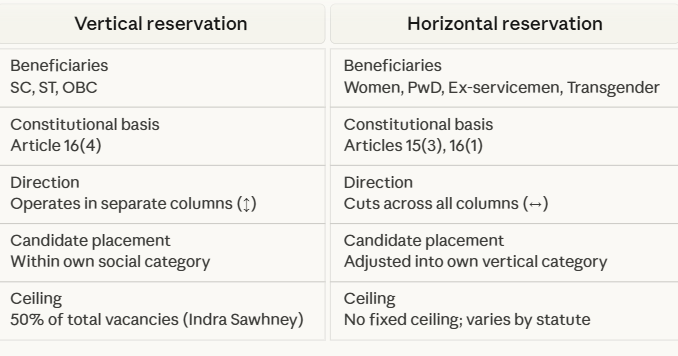
- Vertical reservation refers to the quota prescribed in favour of Scheduled Castes (SC), Scheduled Tribes (ST), and Other Backward Classes (OBC).
- Constitutional basis: Article 16(4) of the Constitution of India.
- It operates by carving out a fixed percentage of total vacancies for each identified social group.
- Candidates within each vertical category compete inter se — that is, among themselves — for the seats reserved for their group.
- The Supreme Court in Indra Sawhney held that vertical reservation must not exceed 50% of total vacancies in a year.
How Vertical Reservation Works:
- Out of the total posts, a fixed number is earmarked for each category — SC, ST, and OBC — separately.
- If a reserved category candidate qualifies on open/general merit (without relying on reserved category relaxation), she is counted against the open/unreserved quota — not against her reserved category quota.
- This ensures that the reserved category quota remains available for less competitive candidates within the same group.
- Example: If 10 SC candidates clear the open merit list, it cannot be said that the SC reserved quota has been exhausted — those 10 must be counted under the open category.
Horizontal Reservation:
About:
- Horizontal reservation refers to the cross-cutting entitlement provided to special groups — women, Persons with Disabilities (PwD), ex-servicemen, transgender persons, etc.
- Constitutional basis: Articles 15(3) and 16(1) of the Constitution of India.
- It cuts across all vertical categories — a PwD or woman candidate may belong to SC, ST, OBC, or the general category, yet still claim the horizontal benefit.
- Unlike vertical reservation, it does not create a separate independent pool of posts.
- Candidates selected under horizontal reservation are placed within their respective vertical social category by making necessary adjustments.
- Even after applying horizontal reservation, the percentage of vertical reservation must remain unchanged.
How Horizontal Reservation Works:
- Suppose 3% of vacancies are horizontally reserved for PwD candidates.
- A PwD candidate belonging to the SC category will be placed in the SC quota after selection; if she qualifies on open merit, she is placed in the open/unreserved quota — adjustments are made accordingly.
- Example: 10 posts are reserved for SC candidates with an internal quota of 2 for SC women.
- Step 1: Fill all 10 SC posts on merit from the SC pool.
- Step 2: Check whether the list of 10 includes 2 SC women.
- If yes — no further action needed.
- If only 1 SC woman is on the list — add one more SC woman from below the cut-off, dropping the last candidate.
- If the list already has more than 2 SC women on pure merit — all of them stay; no excess deletion.
Types of Horizontal Reservation:
- The Supreme Court in Rekha Sharma v. Rajasthan High Court identified two modes of horizontal reservation.
1. Compartmentalised Horizontal Reservation
- The horizontally reserved seats are proportionately divided within each vertical category.
- Example: Out of 10 seats reserved for women from 50 total posts — 4 for SC women, 4 for ST women, 2 for OBC women.
- Seats are not transferable across vertical categories — an SC woman's seat cannot shift to the ST quota.
- Applicable where the recruitment advertisement identifies vacancies category-wise (General/OBC/SC/ST/MBC) for the horizontal group.
2. Overall Horizontal Reservation
- The horizontally reserved seats are applied to the total posts without being tied to any specific vertical category.
- Candidates are adjusted across whichever vertical category they fall in — the seats are inter-transferable.
- The overall horizontal quota must be honoured in full regardless of which vertical compartments the candidates ultimately fall into.
- Applicable typically for PwD reservations, where vacancies are reserved for persons with benchmark disabilities without category-wise bifurcation.
Key Differences:
Landmark Case Laws:
- Indra Sawhney v. Union of India (1992) — The Court distinguished vertical reservation (Art. 16(4), for SC/ST/OBC) from horizontal reservation (Art. 16(1), for women/PwD). It held that horizontal reservation candidates are to be adjusted within their vertical category after selection, and vertical reservation must not exceed 50% of total vacancies.
- Rajesh Kumar Daria v. Rajasthan Public Service Commission (2007) The Court held that if a reserved category candidate qualifies on open merit, she must be counted in the open/unreserved quota and not against her vertical reserved quota. It also laid down the step-by-step procedure for applying horizontal reservation within a vertical category.
- Saurav Yadav v. State of Uttar Pradesh (2020) — The Court held that a candidate at the intersection of a vertical and horizontal reserved category, who qualifies on open merit, cannot be restricted to her vertical quota. Such a candidate must be counted in the open category and cannot be excluded from the horizontal quota applicable to the open category.