


-
- Books & Magazines
- Login
- Language: Eng हिंदी
Home / Editorial
Constitutional Law
Ordinance Increases Number of Supreme Court Judges to 37
« »19-May-2026
Source: The Hindu
Introduction
President Droupadi Murmu has promulgated an ordinance increasing the number of judges in the Supreme Court to 37, excluding the Chief Justice of India (CJI). The Supreme Court (Number of Judges) Amendment Ordinance, 2026, has been promulgated in accordance with the powers of the President under Article 123 of the Constitution.
- The ordinance will be placed in both Houses of Parliament when it convenes, and will cease to operate if six weeks expire without any resolution passed on it after the reassembly of Parliament, or if resolutions are passed in both Houses of Parliament disapproving it. The President can withdraw the ordinance at any time.
.jpg)
Background
- The May 16 Gazette notification states that "Parliament is not in session and the President is satisfied that the circumstances exist which render it necessary for her to take immediate action [issue of ordinance]."
- The ordinance has amended Section 2 of the Supreme Court (Number of Judges) Act, 1956 to replace the word "thirty-three" with "thirty-seven."
- With the ordinance in place, the total sanctioned judicial strength in the Supreme Court, including the Chief Justice of India, will rise from 34 to 38.
Legislative History of the Supreme Court's Sanctioned Strength
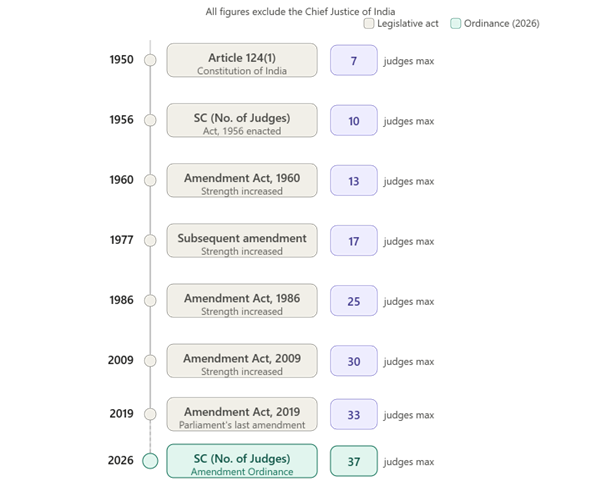
Strength Crisis
- The move is seen as a step towards tiding over the continuing crisis of pendency plaguing the court for years, especially after the COVID-19 pandemic, when the facility of e-filing of cases caught on.
- The current backlog stands at over 93,000 cases, threatening to reach six figures even as the court goes into summer recess or "partial working days" in June.
- At present, there are two judicial vacancies in the top court — those of the previous Chief Justice of India, Justice B.R. Gavai, who retired in November 2025, and Justice Rajesh Bindal, who completed office in April 2026.
- Three more judges are scheduled to retire in 2026: Justices J.K. Maheshwari and Pankaj Mithal will end their tenure in June, and Justice Sanjay Karol in August.
- The government's approval for more judges in the Supreme Court had come after a six-year hiatus, as Parliament had last amended Section 2 of the Supreme Court (Number of Judges) Act, 1956 in 2019.
Ordinances under the Indian Constitution
|
Aspect |
Details |
|
Constitutional Provision |
Article 123 (President); Article 213 (Governor) |
|
Issuing Authority |
President (on advice of Council of Ministers); Governor for states |
|
When Issued |
When either House of Parliament / State Legislature is not in session, in urgent situations |
|
Who Cannot Issue |
Parliament itself cannot issue ordinances |
|
Legal Force |
Same force and effect as an Act of the legislature |
|
Ratification Required |
Must be ratified by Parliament within six weeks of its reassembly |
|
Maximum Validity |
Six months and six weeks from the date of promulgation |
|
Session Date (Two Houses) |
If both Houses begin sessions on different dates, the later date is considered |
|
Role of President |
Acts on advice of Council of Ministers; may return recommendation for reconsideration, but must promulgate if sent back |
|
Withdrawal |
President can withdraw an ordinance at any time |
|
Parliamentary Disapproval |
Both Houses can pass resolutions to disapprove it, leading to its lapse; rejection implies loss of majority |
|
Void Ordinance |
An ordinance is void if it enacts a law beyond Parliament's legislative competence |
Conclusion
The promulgation of the Supreme Court (Number of Judges) Amendment Ordinance, 2026 marks a significant step by the executive to address the acute pendency crisis in the apex court. By raising the sanctioned judicial strength to 37 (excluding the CJI), the ordinance responds to an escalating backlog that threatens to cross one lakh cases. The move, coming after a six-year legislative hiatus on the subject, underscores the urgency of judicial capacity expansion. Its ultimate efficacy will, however, depend on the timely filling of existing and upcoming vacancies and the ordinance's ratification by Parliament.